Few spectacles in the natural world rival the migration of the Olive Ridley turtle, a journey defined by endurance, instinct, and astonishing precision. These ancient mariners traverse thousands of miles across the Pacific Ocean, guided by Earth’s magnetic fields and ocean currents, only to return—often within meters—to the very beaches where they were born.
For travelers and wildlife enthusiasts, understanding Olive Ridley turtle migration patterns opens the door to one of Costa Rica’s most unforgettable natural experiences: the arribada, a synchronized mass nesting event found in only a few places on Earth. Moreover, the migration of Olive Ridley turtles highlights the deep connection between ocean ecosystems and Costa Rica’s protected coastlines. As a result, Costa Rica has become one of the most important destinations in the world for observing sea turtle migration.
Understanding Olive Ridley Turtle Migration Patterns
The Olive Ridley turtle migration is one of the most complex and fascinating movements in the animal kingdom. These turtles spend most of their lives in the open ocean, traveling between feeding grounds and nesting beaches over vast distances.
Scientists believe Olive Ridleys rely on:
- For example, Olive Ridley turtles use Earth’s magnetic fields to navigate vast stretches of the Pacific Ocean.
- Meanwhile, ocean currents help conserve energy during long-distance migration.
- Water temperature gradients
- An internal biological “map”
This natural navigation system allows them to cross entire ocean basins and still return to their natal beaches with remarkable accuracy. Consequently, only turtles in peak physical condition are able to complete the journey successfully.
The Arribada Phenomenon: Nature’s Perfect Timing
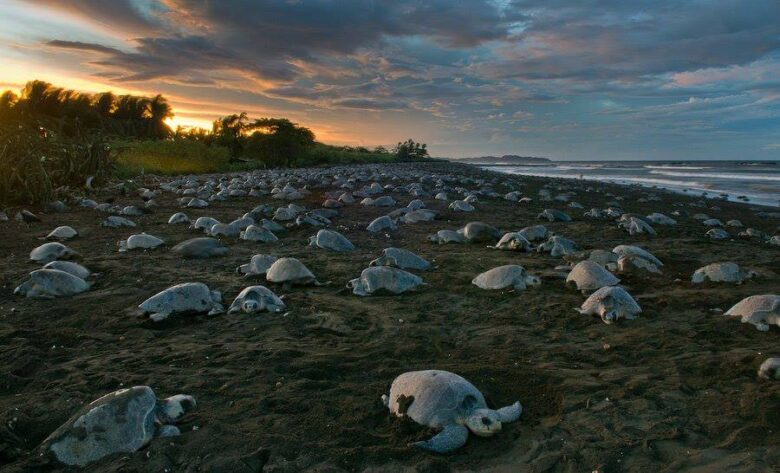
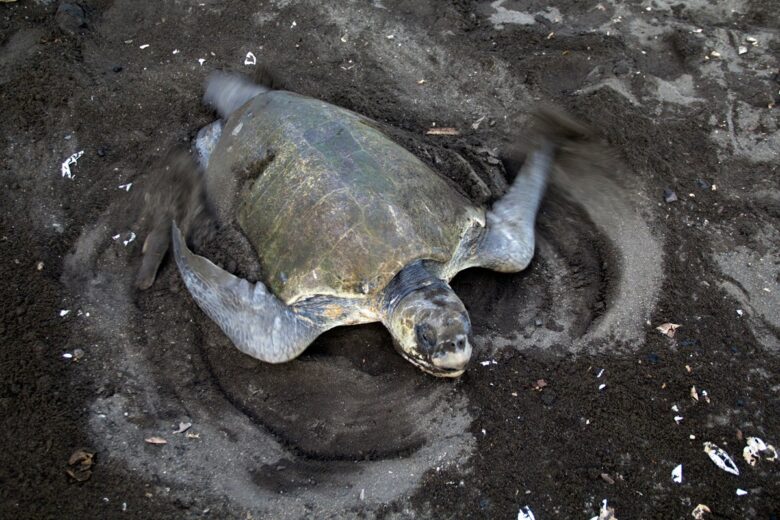
One of the most extraordinary aspects of Olive Ridley turtles in Costa Rica is the arribada phenomenon. During an arribada, tens—or even hundreds—of thousands of female turtles come ashore simultaneously to nest.
Why Do Arribadas Happen?
Researchers suggest several advantages:
- Most importantly, the arribada phenomenon dramatically increases the survival rate of hatchlings.
- At the same time, mass nesting events reduce the risk posed by natural predators.
- Therefore, arribadas represent a highly effective evolutionary strategy.
Costa Rica is home to some of the largest arribadas in the world, making it a global hotspot for turtle conservation and eco-tourism.
Costa Rica: A Global Sanctuary for Olive Ridley turtle migration
Ostional Wildlife Refuge and Beyond of Olive Ridley Turtle Migration
The Ostional Wildlife Refuge on Costa Rica’s Nicoya Peninsula is internationally recognized as one of the most important Olive Ridley nesting beaches on Earth. Here, arribadas can occur year-round, with peak activity typically between August and December.
Other notable nesting areas include:
- Playa Nancite (Santa Rosa National Park)
- Playa Camaronal
- Sections of the central and southern Pacific coast
These protected beaches are essential not only for nesting but for maintaining global sea turtle populations.
Sea Turtle Conservation in Costa Rica
Protecting a Fragile Olive Ridley Turtle Migration Cycle
The sea turtle conservation efforts in Costa Rica are deeply connected to local communities, scientists, and eco-lodges. Threats to Olive Ridley turtles include:
- Climate change and rising sand temperatures
- Plastic pollution and fishing bycatch
- Coastal development
Community-led conservation programs at Ostional allow regulated egg harvesting during early arribada stages—an internationally studied model that has helped stabilize turtle populations while supporting local livelihoods.
When Is the Best Time to See Turtles in Costa Rica?
Turtle Nesting Season Costa Rica
While Olive Ridley turtles nest throughout the year, the best time to see turtles in Costa Rica is during peak arribada months:
- August to October: Highest probability of massive arribadas
- November to December: Continued nesting with fewer crowds
Arribadas often occur at night and are influenced by lunar cycles and tides, making each event unpredictable—and magical.
Why Witnessing Turtle Migration Is a Life-Changing Experience
Seeing thousands of Olive Ridley turtles emerge from the ocean under moonlight is more than a wildlife encounter—it’s a reminder of nature’s resilience and interconnectedness. Their cyclical migration links distant oceans to Costa Rica’s shores, connecting travelers to a rhythm that has existed for millions of years.
For photographers, families, and eco-conscious travelers, this experience offers:
- Rare educational insight
- Ethical wildlife observation
- A deeper connection to conservation
In conclusion, the migration of Olive Ridley turtles is both a scientific marvel and a powerful symbol of nature’s resilience. From vast Pacific feeding grounds to the sandy beaches of Costa Rica, their instinct-driven return is a testament to nature’s precision and endurance. Above all, Costa Rica offers one of the rarest opportunities on Earth to experience this phenomenon responsibly. Finally, choosing the right location to stay can transform a great trip into a once-in-a-lifetime journey.
Next Step: Experience the Arribadas for Yourself
If witnessing the arrival of thousands of sea turtles is on your bucket list, there is no better place to stay than Hotel Boutique Luna Azul. Perfectly located for easy access to nesting beaches, our boutique hotel offers comfort, sustainability, and insider knowledge to help you experience the arribadas at the right time, in the right way.
🌊 Book your stay at Hotel Boutique Luna Azul and become part of one of nature’s greatest journeys.